
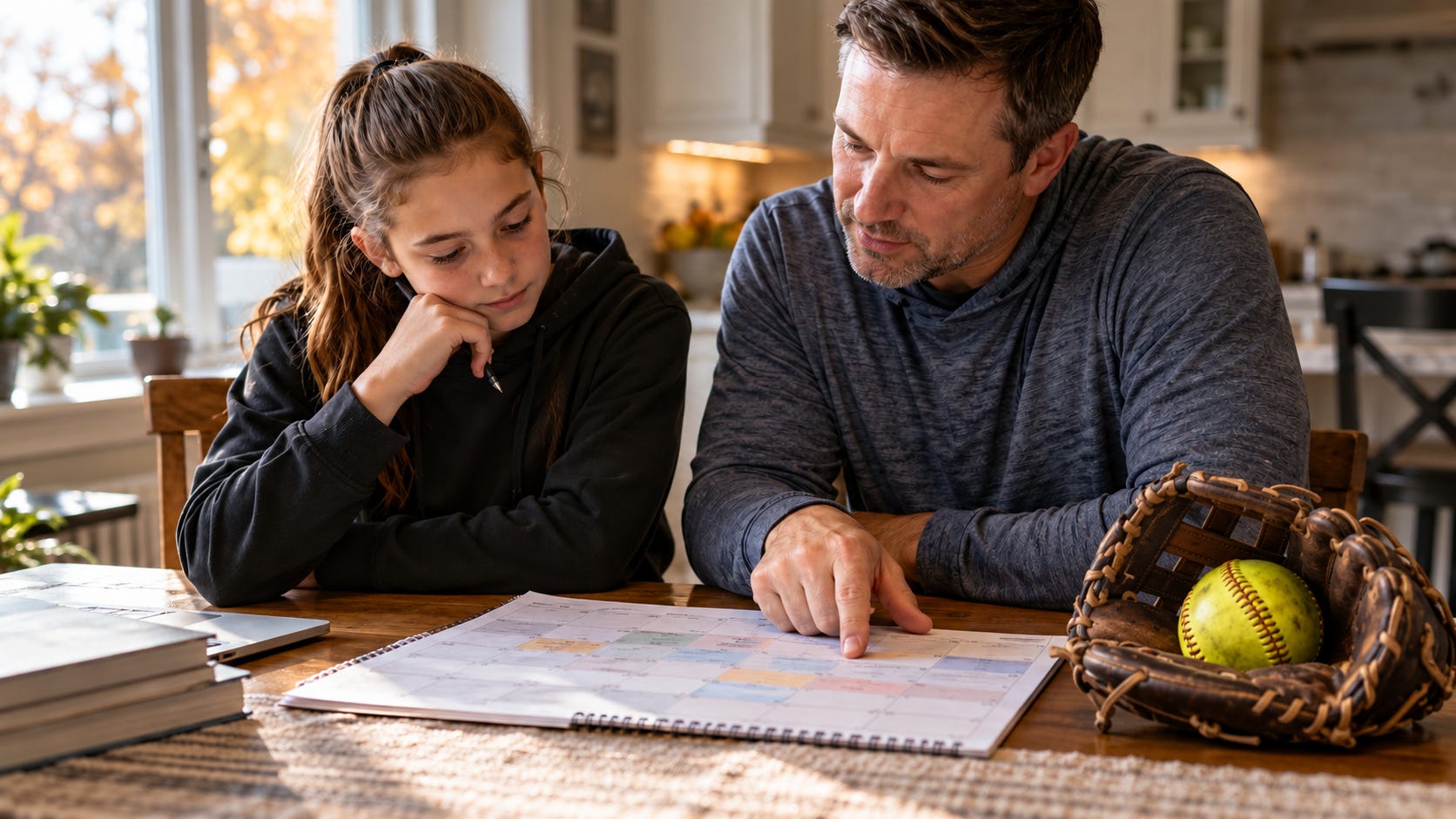
In November, a softball family can find itself in an unusual position. The tournament weekends have slowed down, but the calendar has not. There is a hitting lesson on Monday, team training on Wednesday, a pitching session on Thursday, and an invitation to another clinic on Saturday. Each opportunity seems reasonable when considered alone. A parent who wants to support an ambitious athlete may feel that saying no means allowing somebody else to get ahead.
The difficult part is that youth development does not happen one opportunity at a time. It happens inside an entire life. School, sleep, family obligations, other sports, friendships, and ordinary downtime all share the same calendar. When we evaluate a new training opportunity only by asking whether it might help softball, we leave out the question that matters just as much: what will it displace?
This is not an argument against private lessons or serious practice. Competitive young athletes often enjoy structured work, and good instruction can make a real difference. The idea is that more instruction is not automatically better simply because it is available. The quality of a week depends on the relationship between what we ask the athlete to do and what we leave room for afterward.
The American Academy of Pediatrics has described the risks of repeated training stress without enough recovery, including overuse injuries and burnout. Its 2024 clinical report also emphasizes the value of autonomy, enjoyment, rest from organized sport, and paying attention to signs that a young athlete is struggling. These recommendations are broad youth-sports guidance, not a formula for prescribing an individual softball player’s training load. They are still a useful reminder that the family calendar is part of the training environment.
The calendar can also hide the difference between an athlete choosing to work and an athlete feeling she must work. A child may enjoy a hitting lesson and still dread the drive to the third scheduled activity of the week. She may be excited about a new coach but disappointed to miss a friend’s birthday. Those are not contradictions. They are normal competing interests, and parents are often the only people who can see all of them at once.
It helps to remember that a coach sees a player during a limited slice of the week. A pitching instructor sees her delivery. A team coach sees defensive communication. Neither necessarily sees the late homework night, the early school bus, or the family event that follows practice. That is not a criticism of coaches. It is a reason parents must bring the whole picture into decisions about adding commitments.
One reason this is easy to miss is that adults usually build schedules in pieces. A coach offers a winter workout. A pitching instructor has one opening. A friend invites the athlete to a clinic. Parents coordinate rides, pay the fees, and try to make the pieces fit. Nobody necessarily sits down to look at the full picture from the athlete’s point of view. By the time a week feels overloaded, each individual commitment may already seem too important to drop.
A full calendar is not a development plan
Consider two hypothetical players. One has four organized softball sessions each week, little flexibility, and a family that constantly rushes between commitments. Another has two purposeful sessions, a chance to play a different sport, and room to move, rest, and enjoy being a kid. It would be a mistake to declare either athlete better prepared based on that description alone. The first may be thriving. The second may need more specific work. What we can say is that the number of sessions by itself tells us remarkably little about whether the plan fits the athlete.
The temptation is to treat a calendar as a scoreboard. Four sessions feel more serious than two. A weekend clinic feels like progress because it can be counted. Yet the meaningful questions are harder to measure: Is the athlete learning? Is the work appropriate for her age and experience? Is she getting enough recovery? Does she still want to participate? Can she keep doing this without sacrificing the rest of her life?
It is also worth distinguishing recovery from inactivity. Children and adolescents benefit from varied daily physical activity, as the CDC guidelines explain. A day without organized softball can include walking, biking, playground games, basketball in the driveway, or another enjoyable activity. The AAP also recommends at least one day each week free from all organized sports; replacing softball with another organized sport would not meet that recommendation. Taking space from a particular sport does not require sitting still.
Make the whole week visible
Here is a practical exercise that takes less than fifteen minutes. Draw seven columns, one for each day of the week. Before writing down softball commitments, put in school, travel time, homework, meals, and the sleep schedule your family is trying to protect. Then add practices, lessons, games, other organized sports, and recurring family obligations. Finally, look for open time that truly belongs to the athlete.
This is the Weekly Load Map. It is not a medical assessment, a validated workload score, or a way to calculate the perfect number of throwing repetitions. It helps a parent notice that an hourlong lesson may actually occupy three hours once driving, preparation, and waiting are included. It also helps distinguish a calendar that looks manageable on paper from one that requires rushing through every evening.
A useful second question is whether the schedule has any margin. Margin is the time that absorbs ordinary life: a delayed ride, a difficult school assignment, a sibling’s event, or a child who simply needs an earlier night. If every evening works only when everything runs perfectly, the plan is fragile. Families can be committed to development without designing a week that falls apart when a normal Tuesday happens.
The map does not decide how many lessons are appropriate. It creates the conditions for a more honest judgment.
After drawing the map, ask the athlete to look at it with you. Rather than starting with what she should cut, try this: “Looking at the whole week, what feels useful, and where would you like more breathing room?” Some athletes will want to keep a particular lesson because they genuinely enjoy it. Others may reveal that they are attending something mostly because adults expect it. Either answer gives you information you did not have before.
Keep the work that has a purpose
Once the week is visible, examine each softball session. What specific job does it do? A pitching lesson might address one mechanical adjustment. A team practice might focus on communication and defensive decisions. A short home session might reinforce something the athlete is learning. When every session has a purpose, it becomes easier to see whether another event adds something useful or merely repeats work already on the calendar.
For example, a family might discover that Wednesday team practice and Thursday private instruction both involve demanding throwing work. The right response is not to diagnose an injury risk from a calendar alone. It is to ask the relevant coaches how those sessions fit together, whether the workloads are appropriate, and what should change if the athlete is sore or fatigued. A different family might realize that the Saturday clinic is mostly repetition of a skill already being taught effectively on Tuesday. In that case, skipping it may be an easy decision rather than a lost opportunity.
The same review can protect the activities that make softball worthwhile. Perhaps the athlete loves a weekly session because she gets individual attention and can see what she is learning. Keep that in mind. An intentional calendar does not mean parents choose the smallest possible number of sessions. It means the family can explain why each commitment is there.
It can be uncomfortable to pass on a good opportunity. Families worry about falling behind, especially when other players appear to be doing more. But another family’s schedule is not a reliable standard for your athlete. Children develop at different rates, have different commitments, and respond differently to training. The responsible question is not whether your family is doing as much as everyone else. It is whether the current plan serves this athlete well.
If you want a practical decision rule, try a short pause before agreeing to an optional event. Ask three questions: What is the specific benefit we expect? What does it replace? Does our athlete want this opportunity now? You do not need a spreadsheet or an elaborate training theory to answer them. A short conversation at the kitchen table is enough to expose whether the new commitment fills a real need or merely responds to the fear of missing out.
It is fair to revisit the decision later. An offseason is not a contract to repeat the same week until spring. School demands change, bodies grow, family schedules shift, and athletes sometimes discover new interests. Reviewing the calendar every few weeks gives the family permission to adjust without treating every change as a failure of commitment.
Parents should also take persistent pain, changes in sleep, unusual fatigue, and declining enjoyment seriously. Those signs are not proof of overtraining, and a calendar exercise cannot diagnose anything. They are reasons to pay attention, reduce unnecessary pressure, and seek appropriate professional guidance when symptoms warrant it. A good offseason plan should not depend on ignoring what an athlete’s body or behavior is telling us.
Leave something unscheduled
One of the most useful decisions a parent can make may be to protect an open block of time before someone else fills it. That does not mean the athlete has to waste the afternoon. It means she gets a chance to choose. She might practice on her own, play outside, visit a friend, read, or do nothing especially productive. There is value in having part of childhood that is not measured by improvement.
The goal is not to make a calendar look empty. The goal is to make it intentional. Competitive softball can be an important part of family life without becoming the organizing principle for every available hour. A child who wants to work hard deserves adults who help her train thoughtfully, not simply endlessly.
This week, put the entire schedule on one page. Ask which commitments have a clear purpose, which are duplicating work, and where your athlete has genuine choice. You may decide nothing needs to change. You may decide one optional session can wait. Either way, you will have made the decision by looking at the whole athlete rather than one more opportunity.
What is the hardest part of protecting open time during your family’s offseason? I would be interested to hear how other softball families are handling it.