
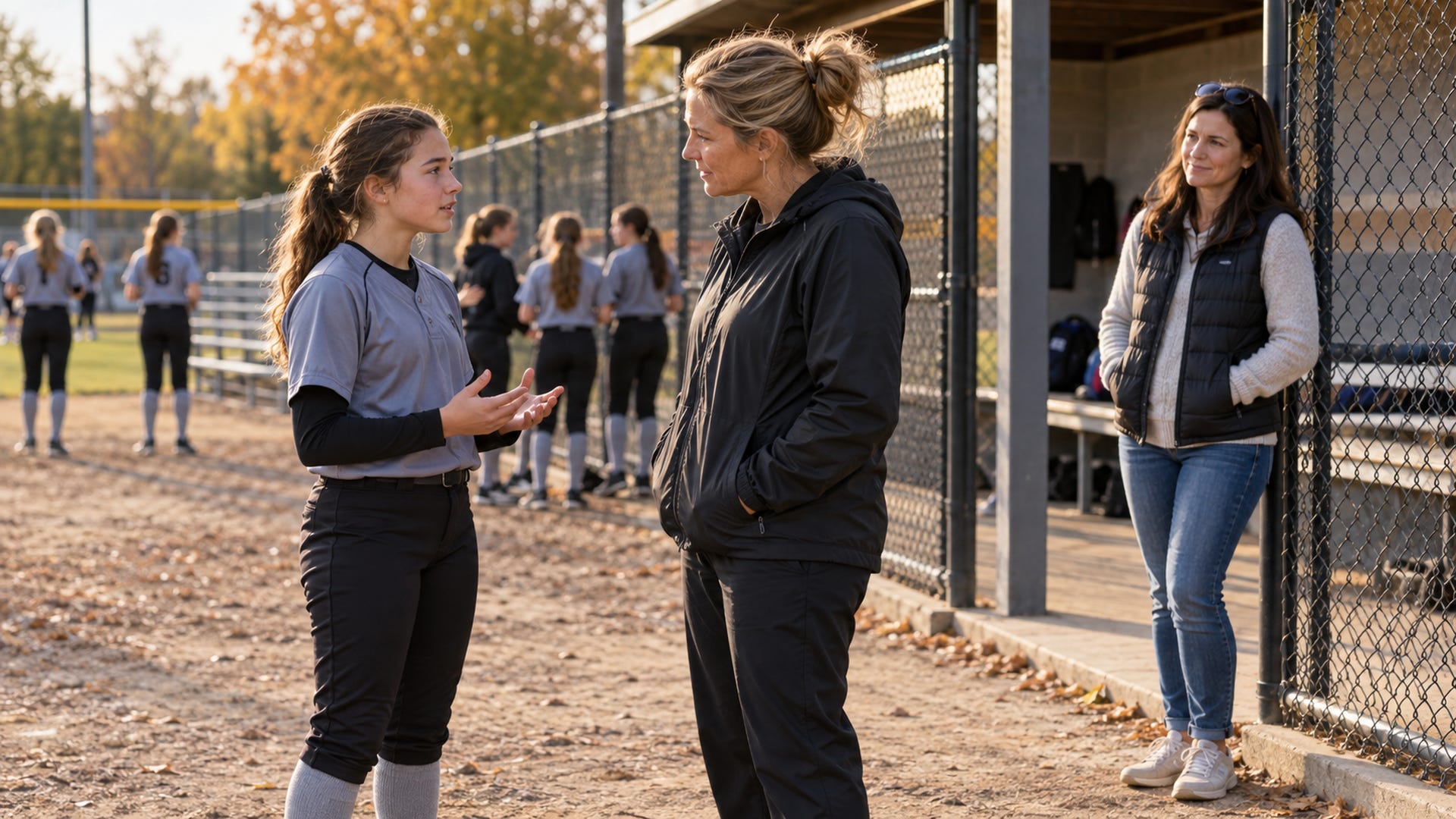
Picture the end of a softball practice. The buckets are being carried off, a few girls are still looking for their water bottles, and your athlete slows down before reaching the parking lot. She has a question for the coach. Maybe she wants to understand her role. Maybe she does not know what a piece of feedback meant. She has been talking about it with you, but now that the coach is right there, she asks, “Can you just ask?”
You probably could. You know the background, you can keep your thoughts organized, and you do not have to work up the courage to approach an adult who decides where you play. Sending a quick message would be easier for everyone in the next five minutes. The harder question is whether doing it for her is the help she needs this time.
For an ordinary development conversation, a parent can make the first step smaller without taking it away. Help her practice an opening, agree on what support she wants, and give her a chance to begin. She does not have to sound polished. She needs a reasonable opportunity to use her own voice.
Begin with the question she actually has
Before you rehearse anything, find out what she wants to understand. A parent can hear “I don’t know why I’m in the outfield” and immediately start building a playing-time argument. The athlete may simply want to know where to line up, whether the move is temporary, or what she needs to practice. If you supply the complaint, the conversation can become yours before she says a word.
Ask her to put the question in her own language. You might say, “What do you want to know when you’re finished talking?” Then listen long enough for her answer to be different from the one you expected. Help her separate a question she can ask the coach from a conclusion she has already reached. She can be disappointed and still ask for information.
Choosing useful questions and a true example is a good start. The next step is making room for her to carry that preparation into the actual conversation. You do not need to add another speech about responsibility on the way across the field.
Practice only the opening
An entire conversation is hard to rehearse because you cannot know what the coach will say. The first sentence is manageable. Try, “Coach, when would be a good time to ask you about my role?” If the question is about a drill rather than a role, change those last words. It should sound like something she would say, not a formal email read aloud.
Give her a simple invitation: “Want to practice how you’ll start? Would you like me beside you or nearby?” Let her say the opening once while you play the coach. Answer normally. You do not need to challenge her, interrupt her, or turn the kitchen into a cross-examination. The point is to make the beginning familiar, not prove she can survive the worst possible response.
If she wants another try, give her one. If she likes different words, use them. A younger player might say, “Coach, can I ask you something after practice?” That can be enough. Rewriting every sentence until it sounds more mature teaches her that her own language is not good enough to start.
Agree on where you will be
“You need to do this yourself” can sound like a parent withdrawing support just as the task gets uncomfortable. Instead, make your part clear. Would she like you beside her while she opens? A few steps away? Does she want help arranging an appropriate time? The support should fit the athlete, including her communication needs, not an adult’s preferred test of toughness.
For one 10U player, success may be asking the opening question with a parent standing next to her. An older athlete who already knows the coach well may be ready to lead more of the exchange. Age alone does not settle it. A player who needs accommodations should not have to earn them by becoming distressed first. Keep enough support for her to participate meaningfully.
Agree on how she will ask for help if she gets stuck. She might look toward you, ask you to repeat the question, or say, “Can you help me explain?” Then help with the part she needs. Being available is different from answering the moment there is a pause.
Let the pause happen
That pause may be the hardest part for the parent. She says the opening, the coach responds, and now she has to find the next words. You know them. You have heard the question three times at home. It can feel almost rude to leave everyone waiting while you stand there with the answer.
Give her a little room. A moment of thinking is not necessarily a request for rescue. Avoid finishing her sentences, adding the strongest example, or correcting a harmless detail while she is trying to speak. If she asks for help, help. If she is overwhelmed, slow down or arrange another time. The aim is participation, not making her struggle in public to prove a point.
The coach also has a job here. A useful response makes it possible for the athlete to ask, listen, and clarify without being embarrassed for trying. Parents do not control that response. If a routine question is repeatedly dismissed, a parent may need to seek a supported meeting through the team’s communication process. Athlete ownership should not become an excuse for adults to be unapproachable.
Keep ownership and safety together
Letting her speak does not mean sending her into an isolated meeting. Have the conversation in a visible, accessible setting where another person can step in. If she writes to the coach, use the team-approved channel and keep an appropriate adult included. She can compose the words and press send without having a private message thread with an adult.
The U.S. Center for SafeSport explains these safeguards through observable and interruptible in-person contact and open and transparent electronic communication under the Minor Athlete Abuse Prevention Policies (MAAPP) within the U.S. Olympic & Paralympic Movement. Families should follow their organization’s policies. The practical point is simple: learning to communicate and maintaining adult safeguards belong together.
There is also a firm limit to this week’s advice. Suspected abuse, threats, retaliation, discrimination, injury concerns, or other safety problems are not communication exercises for a child to solve alone. A parent should act through the appropriate adult and reporting channels. A child saying she is afraid deserves listening and attention, not an automatic instruction to be braver.
Measure something besides the answer
The coach may give a useful answer, need another time, or say something the athlete does not want to hear. None of those responses tells the whole story of whether taking the first turn was worthwhile. An ordinary development conversation is not a guarantee of a new position or more innings. It is an opportunity to ask for information and learn what to do with it.
Afterward, resist the urge to grade how she spoke. Start with, “What did you hear?” That gives her a chance to process the answer before your interpretation fills the space. If she cannot explain the next step, help her identify what needs clarifying. She may need to ask the coach for one example, write down a practice priority, or arrange a follow-up through the team’s usual process.
Research on sports parenting supports preserving an athlete’s voice within a supportive relationship. A 2024 systematic review by Gao and colleagues identifies autonomy-supportive involvement as a useful feature of youth-sport parenting. It does not prove that a particular sentence produces confidence or that every athlete should handle the same amount alone. The practical judgment is to provide enough help for her to take a real part.
Before the next routine coach conversation, try one rehearsal. Ask what she wants to understand, let her practice the opening, and agree on where you will be. When the moment comes, give her the first turn. You can still be her parent, still be available, and still let the coach hear from her.